Showing posts with label Tudor. Show all posts

Friday, October 16, 2015

The Taming of the Queen

Summary:
            The post-Pilgrimage of Grace religious upheaval late in Henry VIII’s reign finds credence in another of Philippa Gregory’s prolific Tudor series. The protagonist in this story is Kateryn Parr, the sixth wife of England’s most notoriously wedded monarch. While most readers know her fate, the author puts a spin on the tangle of rival factions and also describes the reasoning behind the madness of the King of England.


Review:
Why would anyone knowingly marry a serial killer? In the most recent installment of Philippa Gregory’s Tudor Court series, The Taming of the Queen, the answer to that question becomes all too clear: because he is the KING! Kateryn Parr, the final Queen in the reign of Henry VIII, is the subject of this latest piece of historical fiction. Picking up shortly after the execution of Katherine Howard, King Henry’s fifth wife, this book introduces the world to the little known Queen Kateryn.  With most of the attention given to the more eccentric and flashy queens like Anne Boleyn and Katherine of Aragón, little has been published about Queen Kateryn until recently. I was pleasantly surprised to find that she is just as noteworthy as the more scandalous wives of King Henry.

As the story begins, thirty-year-old widow, Kateryn Parr, is in a secret affair with Thomas Seymour. After involuntarily catching the eye of the king, she is forced to end her secret affair and marry a man old enough to be her father…A man who has notoriously buried four wives - King Henry VIII. Kateryn is fully aware of the danger she faces. She is attentive to the fact that the previous queen lasted only sixteen months, and the one previous scarcely half a year. As much as her logical reservations tempt her to quickly turn tail and run, she knows that her fate would be much worse if she did. In her mind, either way, she is a dead woman walking.  She decides to accept the King’s proposal and marries him, much against her better judgement.
She takes some comfort in the fact that King Henry initially adores his new bride. She is kind and gentle with the infamous wife killer, even as he suffers from a chronic leg injury that skews his attitude and judgement in a most violent and sporadic way.  Kateryn slowly begins to trust him and makes great efforts to unite his extremely fragmented royal family. Her success leads her to be allowed more freedom. She uses this new found trust to create a free thinking study group at the heart of the court, and even rules as Regent in the absence of the King.


As trusted as she seems to be, are her efforts enough to keep her safe? As her influence as a religious reformer grows, suspicion of the Queen runs rampant amongst the anti-protestant movement that is sweeping the country. Kateryn dangerously stands out as an independent woman with a mind of her own, as evident in being the first woman to publish in English. Her exertions and sacrifices, however, are for naught as Henry’s perilous gaze turns on her.  Persuaded by the clergy and other power hungry rivals, Kateryn finds herself accused of heresy. The punishment for such a crime is death by fire, and her husband, the king, has signed the warrant…

(As those who regularly read the Lit Writ know, it can be safely assumed that Philippa Gregory is my favorite writer in this genre. So, in the spirit of full disclosure, I feel I must preface the following commentary by divulging that bit of info.)

After finishing the previous book in this series, a small part inside me was sad to say the very least. Like an addict, I searched frantically to find my next historical fiction fix. After reading several other authors, who were fantastic in their own right, I was still left feeling a little empty. Then, much to my joyous elation, I saw The Taming of the Queen on an upcoming release list and immediately put it on hold. While this is not my favorite book in the series, I am happy to report that I learned more from this work than from any of the others.

Kateryn Parr is a little known force in the long list Henry’s wives. She was well educated and strong willed. Considerably older than most of Henry’s brides, Kateryn was the perfect match for an aging and debilitated Henry. She managed to bring his royal children all under the same roof…a feat unsuccessfully attempted by others in the past. While Henry was easily swayed by his mates in religious matters, she was the first to have the royal authority to translate and publish religious works into the common tongue – an allowance that almost cost her her life. Ultimately, in a great disservice to her legacy, history would push her aside in favor of more “Hollywood- ready” queens like Anne Boleyn and Katherine of Aragon.  This, however, does nothing to diminish her spirit and achievements throughout her reign.

As I close yet another series by Philippa Gregory, I am sadden by the fact that it is over, while none the less excited that I was able to delve into such a little known Queen who pleasantly surprised me with her tenacity and bravery in the face of a monstrously evil force like King Henry VIII. I highly recommend not only this book, but the entire series to anyone interested in this time period. I give The Taming of the Queen 4 stars and look forward to devouring whatever dynasty Philippa Gregory decides to tackle next.


Tuesday, September 22, 2015

The Crown


Summary:
Joanna Stafford, a Dominican nun, learns that her favorite cousin has been condemned by Henry VIII to be burned at the stake. Defying the rule of enclosure, Joanna leaves the priory to stand at her cousin’s side. Arrested for interfering with the king’s justice, Joanna, along with her father, is sent to the Tower of London.

While Joanna is in the Tower, the ruthless Bishop of Winchester forces her to spy for him: to save her father’s life she must find an ancient relic—a crown so powerful, it may possess the ability to end the Reformation.

With Cromwell’s troops threatening to shutter her priory, bright and bold Joanna must decide who she can trust so that she may save herself, her family, and her sacred way of life. This provocative story set in Tudor England melds heart-stopping suspense with historical detail and brings to life the poignant dramas of women and men at a fascinating and critical moment in England’s past.

Review:
One day at the library, I was discussing with a well-read patron my need for a new historical fiction writer, as I had exhausted many of the works of my favorites. She suggested Nancy Bilyeau, an author whose name I had heard mentioned in various historical fiction circles. I searched within the libraries catalog and was pleasantly surprised we carried the very book the patron had stated was the one that got her hooked on the author. I immediately went to the stacks, pulled the book, and began to devour it on my lunch break, and might I say:  Who knew the lives of nuns and monks could be so exciting?
After reading, “The Crown”, Nancy Bilyeau’s first installment in the Joanna Stafford series, my assessment of the men and women of the cloth has gone from one of meek and mild-mannered devotees to that of cunning and intelligent sleuths doing all they can to protect their home, faith, and way of life. The story begins with Joanna Stafford, a young and naïve member of the fallen royal Stafford house recently turned novice Dominican nun, wandering unaccompanied through London’s Cheapside. King Henry VIII has announced that there is to be a traitor burned at the stake, and Joanna is desperately searching for its location to confirm her worst fear—that the intended burn victim was to be her beloved cousin Margaret.
Margaret, like many devout Catholics at the time, was angered and enraged by King Henry’s nonchalant casting off of the old ways in favor of the new religious separation from Rome. This separation was brought about by Henry’s anger over not being granted an official divorce by the Pope, allowing him to marry his Boleyn mistress. All who opposed him by standing up for their religious beliefs were labeled traitors and effectively dealt with as such. Margaret was no exception. Accused of leading an uprising, or rather not talking her husband out of a revolt, she is sentenced to death by burning. Catching wind of King Henry’s intentions for her cousin, Joanna sneaks out of Dartford Priory to try to convince those in charge that her cousin should be spared. That is when her trouble begins.
After attempting to be near her cousin in her finals moments of life, Joanna is accused of trying to help Margaret escape, and finds herself locked in the Tower of London. While held captive, she has a chance run in with treacherous and deceitful Bishop Gardiner, who bribes her to join his search for the infamously cursed Athelstan Crown. This sets Joanna off on a path of mystery and intrigue, leading her to not only question the church, but her own faith as well. With a new obstacle around every corner, Joanna finds herself in some not-so-nun-like situations, relying on her wit and instincts to pull her through, while all along attempting to preserve her commitment to not only her family, but the fold as well. With the amount of excitement and deceit that unfolds along her path, it is easy for the reader to forget they are reading about nuns, monks and priests.
As a self-proclaimed historical fiction junkie, I must say I am rather impressed with Nancy Bilyeau’s novel, “The Crown”. While it is not a easy to devour as a Philippa Gregory novel, (I am a little bias, as Ms. Gregory is my favorite author of all time) it is closely comparable and is chalked full of good, down and dirty Tudor suspense, stratagem, and huggermugger. I would highly suggest this as a good place to venture once you have exhausted the entire Gregory catalog. I give this book 4 stars overall and 5 stars for the mysterious plot line. I look forward to reading another of her works soon!


Wednesday, September 24, 2014

The White Queen


Summary:

In 1464, the War of the Roses between the Houses of York and Lancaster is in its ninth year.  Although the sly Earl of Warwick has succeeded in having the easily-controlled Edward IV of York crowned, all his work could be undone when the new monarch falls in love with Elizabeth Woodville, a commoner.  This BBC adaptation of Philippa Gregory's series, The Cousin’s War, follows the women caught up in the battle to be the rightful king of England.
This show was commissioned by the BBC and aired in the UK first.  However, an 'uncut' version of the show was later shown by Starz in the US.
(From TV.com)


Review:

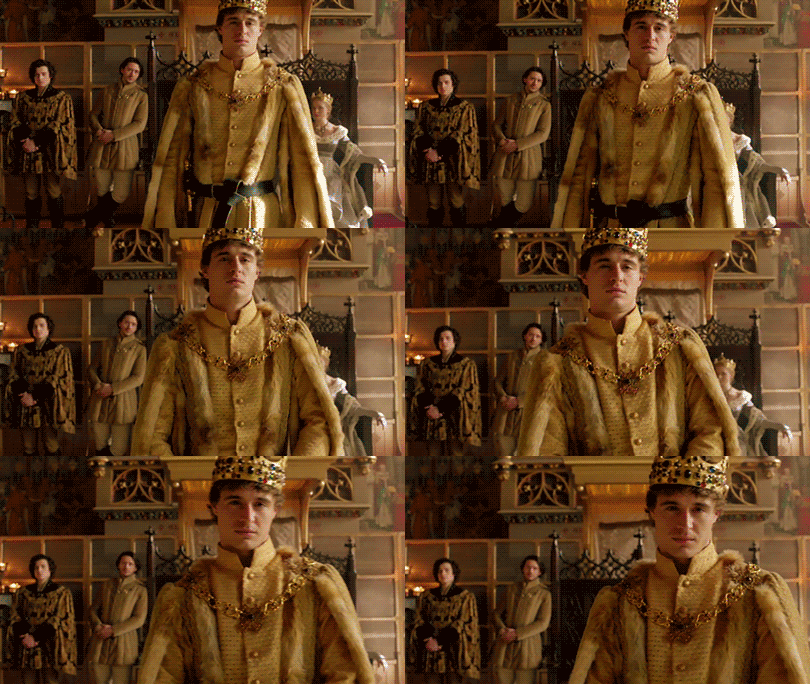
 Having read Philippa Gregory’s Cousin War Series (The White Queen, The Red Queen, and The Kingmaker’s Daughter), I was over the moon excited to find that Starz and BBC had created a made for TV series sculpted after the novels. With Philippa Gregory as executive producer, I hoped that the series would run true with the books, and I was not disappointed. Set in late 1400’s England, The White Queen brings viewers inside the intriguing and secretive world of the York and Lancastrian dynasties. Starting with the chance meeting of Elizabeth Woodville and Young King Edward, The White Queen depicts the a more intimate side of the English court. The series allows the viewer to catch a glimpse of the ethereal royals in very earthly and precarious situations ranging from adultery, jealous rages, and blissful unions.

 To draw comparisons between the books and the series, one would assume, would cause me to find great fault where actor choice and scene selection are concerned. Surprisingly, that did not occur. The choice of actors for the roles of  Queen Elizabeth Woodville, Richard Duke of Gloucester, (later King Richard III), Anne Neville, and Lady Margaret Beaufort were exceptionally true to their descriptions in the books, leaving me to wonder if someone was spying on my mind’s eye as I read the novels. I was particularly thrilled that the scenes from the books that were omitted in the series were few, and those included were taken directly, word for word, from the pages of the three novels. My only criticism is the manner with which the series ends. Originally, the White Queen was to have multiple seasons in order to encompass the breadth of material in the novels. After mixed reviews on the BBC, the series was pulled, leaving those who have not read the books at the edge of an exceedingly lofty cliffhanger. With that said, it was an appropriate place to end had another season been in the works. My suggestion would be to read the three novels, or her entire Cousins War series if you are feeling adventurous, and then watch the series. Doing so will give you a greater appreciation for the close relationship between what was written and what was shown, as well as not leaving you wanting when the series is over. I give this series four stars. It could easily have been a five if the series had not been canceled. The books, however, get a resounding and bold five stars!